

A conversation families are having alone
Black teen drivers and their families navigate risks on the road that standard driver education does not address — including how to safely and confidently handle interactions with law enforcement during a traffic stop.
Families are often left to have this conversation on their own — without curriculum support, standardized guidance, or classroom reinforcement.
Four components, one supplement
Designed to complement existing driver education curricula — not compete with it.
De-escalation & documentation
De-escalation techniques, documentation steps, and know-your-rights guidance appropriate for a teen audience.
Family-conversation guide
Supports the discussions parents and caregivers are already having at home, with structure and shared language.
Culturally responsive materials
Classroom materials designed to complement — not replace — existing state-approved driver's ed curricula.
Instructor guide
Direction for delivering the content sensitively and effectively in mixed classrooms.
Why Does This Initiative Exist?
The numbers behind why Black teens and their families need more than standard driver education — and the practical resources that help them prepare.
Black drivers age 16 and older reported being pulled over at a higher rate than White drivers age 16 and older.
According to the Bureau of Justice Statistics, Black teen drivers were more likely than White teen drivers to report being pulled over in a traffic stop during their most recent contact with police. This finding comes from drivers age 16 or older, so it is presented here as broader traffic-stop context for Black teens rather than as a teen-specific statistic.
Source: Bureau of Justice Statistics, Police Behavior During Traffic and Street Stops, 2011 (published 2013), reporting 2011 Police-Public Contact Survey data. Read the complete BJS report →

SEARCHES DURING TRAFFIC STOPS
Among young male drivers who were stopped, Black drivers were searched at a higher rate than White drivers. This is broader driver data, not a Black-teen-specific statistic, but it provides context for why preparation and calm decision-making matter.
Source: Bureau of Justice Statistics, Characteristics of Drivers Stopped by Police, 2002 (published 2006), reporting 2002 Police-Public Contact Survey data for young male drivers. Read the complete BJS report →
This supports teaching teens:
- How to remain calm
- How to communicate respectfully
- What their rights are
- Why keeping illegal items out of a vehicle protects everyone inside
Black Youth Experience More Police Contact
Research shows that Black youth experience police contact more frequently than White youth. In one national study, 39% of Black boys reported being stopped by police, compared with 23% of White boys. Among girls, the rates were 14% for Black girls and 10% for White girls.
These disparities help explain why some Black teens and their families may approach police encounters with greater fear, concern and a strong need for preparation. Preparation does not mean assuming every encounter will be unsafe. It means helping Black teens develop a plan for remaining focused, communicating clearly and making decisions that protect their safety.
Source: American Journal of Public Health, national study of police contact among youth →
Fear Is Real. Preparation Can Help You Stay Focused.
For many Black teens, fear during a police encounter may be influenced by personal experiences, family conversations, racial profiling, community history, or incidents involving other Black people. Fear can affect breathing, concentration, communication and the ability to process instructions quickly.
A frightened teen may panic, misunderstand instructions, speak too quickly, freeze, make sudden movements, reach for a phone or consider driving away. These reactions may be interpreted differently than intended and can increase the danger of the encounter.
Taking a slow breath, keeping both hands visible, listening carefully and explaining before reaching for anything can help a teen remain focused on the next safe decision.
- Take a slow breath and focus on the next safe decision.
- Pull over safely and remain in the vehicle unless instructed otherwise.
- Keep your hands visible and avoid sudden movements.
- Listen carefully and follow instructions.
- Before reaching for your license or registration, calmly explain where it is and ask before moving.
A Black teen's fear may be genuine, but fleeing can quickly turn a traffic stop into a dangerous pursuit. Driving away can increase the risk of a serious crash, injury or death, place passengers and bystanders at risk, and may lead to arrest, additional charges or loss of driving privileges.
Even if a stop appears unfair, pull over safely, remain calm and address any legal violation or officer misconduct afterward with a parent, guardian or attorney.
Friends may pressure a Black teen to speed, drive recklessly, use marijuana or alcohol, or allow drugs, open containers or weapons inside the vehicle. The driver should establish firm rules: no impaired driving, no reckless behavior and no prohibited items in the car.
Even when an item belongs to a passenger, its presence may lead to a traffic stop, vehicle search, detention or criminal investigation. Protecting friendships should never come before protecting your life, freedom and future.
Talk with a parent or guardian before a traffic stop occurs. Know the expectations for the vehicle, understand the laws that apply in your state, know how the camera operates, and decide in advance how you will respond if you feel frightened, pressured or confused.
Feeling afraid does not mean you have done anything wrong. Questions about a stop or an officer's conduct can be documented and addressed afterward with a parent, guardian or attorney.
Black Drivers Experience Documented Traffic-Stop Disparities
Research involving nearly 100 million traffic stops found that Black drivers were stopped more frequently than White drivers and that, once stopped, Black drivers were searched approximately 1.5 to 2 times as often.
These documented disparities help explain why Black teens and their families may approach traffic stops with heightened concern. Preparation, state-specific legal knowledge and an automatically operating vehicle camera can help families prepare for situations that may otherwise feel uncertain or overwhelming.
Source: Stanford Open Policing Project →
Motor vehicle crashes remain a leading cause of teen death
According to NHTSA and CDC, teen drivers face some of the highest crash risks of any age group on the road.
The CDC reports that each additional teenage passenger increases the crash risk for an unsupervised teen driver — a key reason peer pressure and passenger choices matter behind the wheel.
NHTSA's leading contributors to teen crashes
These five factors show up again and again in teen crash data.
Helping Black Teens Make Safe Choices About Alcohol and Drugs
For Black teens and their families, conversations about alcohol and drugs should include how impairment can affect driving decisions, passengers, judgment and the ability to respond safely to unexpected situations. Parents and guardians can help by having these conversations before a teen is faced with pressure to drink, use drugs, ride with an impaired driver, or drive after using a substance.
For Black Teens, Buckling Up Is About Protecting Your Future
Seat belt use is one of the simplest safety decisions a Black teen driver or passenger can make before a vehicle ever moves. National crash data provides important context, while Black-specific youth research helps us understand the experiences and safety behaviors of Black teens.
Research has examined seat belt habits among Black high-school students, giving families and teens a more relevant picture of transportation safety.
CDC's 2019 Youth Risk Behavior Survey found that 61.7% of Black high-school students reported not always wearing a seat belt. This is a self-reported measure of seat belt use among Black students — it is not a measure of crash fatalities.
Whether you are driving or riding with friends, make buckling up automatic. Your safety matters, your future matters, and getting home safely matters to the people who care about you.
A Record When Your Word Is Questioned
Black teens and their parents may worry that what happens during a traffic stop will later become one person's word against another's. A properly installed dash and cabin camera can create an independent record of what was said and done.
An automatically operating camera may:
Recording laws, audio-consent rules, windshield-mounting restrictions, and privacy laws vary by state. Families should check the rules where they live before installing or using an in-vehicle camera.
Practical tools, knowledge, and confidence
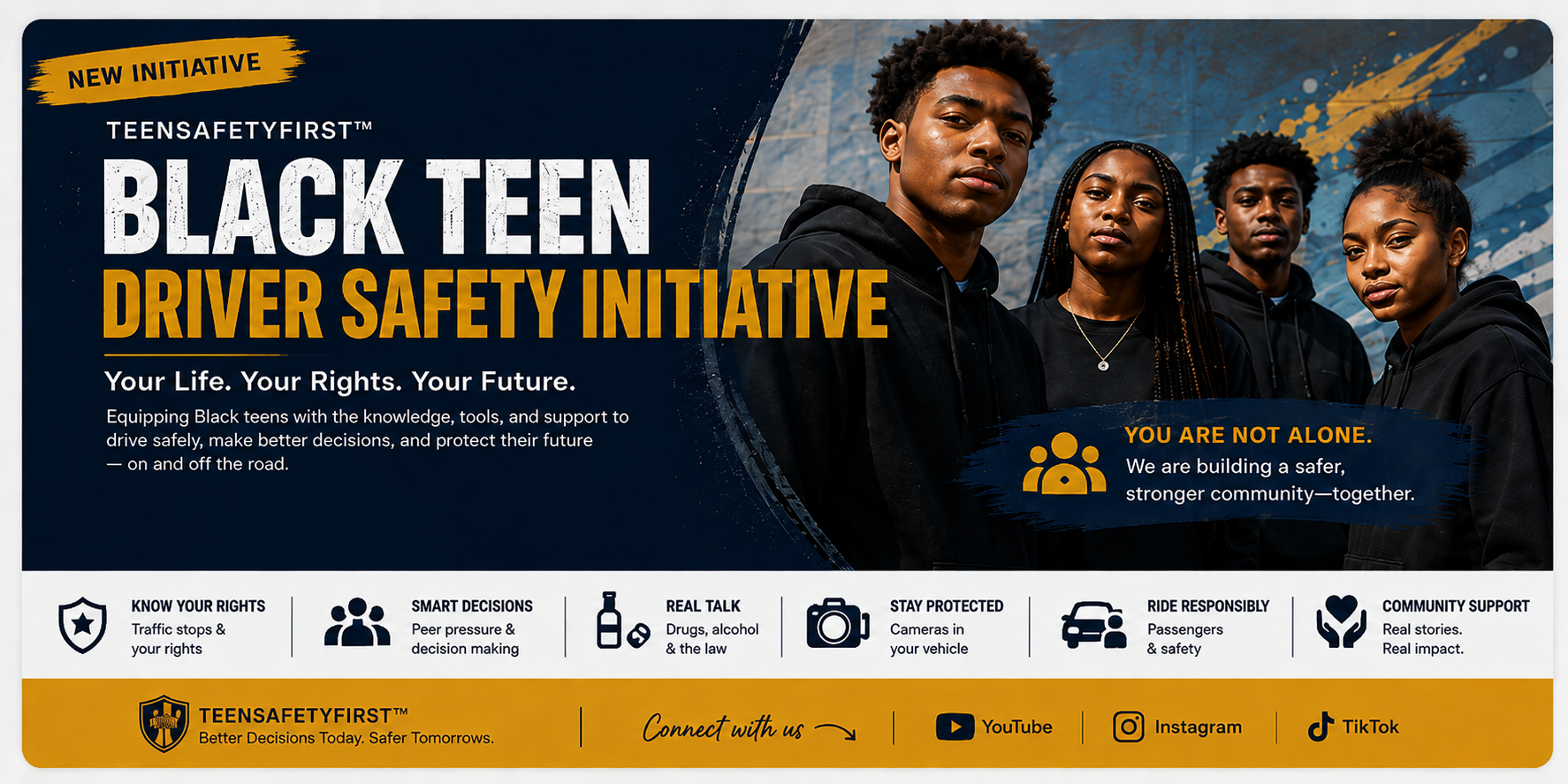
The TeenSafetyFirst™ Black Teen Driver Safety Initiative was created to provide Black teens and their families with practical tools, knowledge, and confidence to make safer decisions before, during, and after every trip.
We want Black teens to understand their rights, make responsible decisions, build positive relationships within their communities, and arrive home safely every time they get behind the wheel.
BLACK TEENS. INFORMED. PREPARED. EXPECTED HOME.Black teens may begin driving with concerns that extend beyond learning road signs and passing a driving test. They may carry fear about traffic stops, racial profiling, being misunderstood or not being believed. They may also face peer pressure involving reckless driving, alcohol, marijuana, weapons, unsafe passengers and decisions that can change their lives within seconds.
This initiative gives Black families practical tools for preparing before these situations occur.
Eight areas, one connected curriculum
Traffic Stops & Knowing Your Rights
How to stay calm, communicate clearly, and understand your rights during a stop.
Peer Pressure & Smart Decision-Making
Recognizing pressure from passengers and making safer calls in the moment.
Cameras Inside Your Vehicle
Why documentation protects you, and how to use it responsibly.
Drugs, Alcohol & Weapons
Understanding the risks — legal and physical — of what's in the vehicle.
Parents Matter
Guides that support the conversations families are already having at home.
Black Teen Stories
Firsthand accounts that make the lessons real, not abstract.
Black Family & Community Support
Connection with others navigating the same road, literally and figuratively.
TeenSafetyFirst™ Resources
Checklists, videos, and articles available any time you need them.

An Anonymized Story Based on Black Youth Experience
Stories can help Black teens and their parents or guardians think through the emotions and decisions that can arise during a traffic stop. The following story is anonymized and is presented as an educational example, not as a claim about one identifiable individual or every police encounter.
Malik had always been afraid of police. The stories he heard from relatives, videos he watched online and experiences in his neighborhood led him to believe that every officer viewed Black teens as a threat.
Through a youth safety program, Malik met an officer who listened without dismissing his concerns. They discussed racial profiling, traffic-stop fear and why sudden movements can be misunderstood. The officer also acknowledged that unfair and harmful police encounters do occur.
Malik did not leave believing that every officer would always act properly. He learned something more practical: police officers are individuals—not automatically his enemies—and preparation, communication and accountability matter on both sides.
“I can remain aware of the risks without assuming that every officer intends to harm me.”
This story does not ask Black teens to ignore legitimate concerns about racial profiling or harmful encounters. It reinforces a practical goal of preparation: recognize the risks, stay as calm as possible, communicate clearly, understand basic rights, and avoid making a dangerous situation worse through sudden or impulsive decisions.
Educational note: This is an anonymized story based on Black youth experience and is not presented as a verified account of a specific person.
Resources Already Developed for Black Teens and Their Families
TeenSafetyFirst™ already has educational materials designed to help teens, parents and guardians prepare for driving decisions, traffic stops, family conversations and other safety situations. This page directs visitors to those existing resources rather than duplicating them.
Assessments, Checklists, Toolkits & Educational Materials
Visit the TeenSafetyFirst™ Resources page for assessments, checklists, toolkits and other educational materials available through the website.
VIEW TEENSAFETYFIRST™ RESOURCESParent Thinking Guide
The Parent Thinking Guide provides conversation suggestions and practical information to help parents and guardians talk with their teens about driving safety, traffic stops, preparation and responsible decision-making. Families should begin these conversations before an emergency or traffic stop occurs and develop a clear family safety plan.
FIND THE PARENT THINKING GUIDEQuick Thinking Guides — All 50 States + Washington, D.C.
The Quick Thinking Guides provide state-specific traffic-stop information, traffic laws and practical guidance for teens and families. Select the guide for your state or Washington, D.C. from Lori A. Mosby, J.D.'s Amazon Author Page.
VIEW STATE GUIDES ON AMAZONTraffic laws and procedures vary by jurisdiction. For that reason, this initiative directs Black teens and their parents or guardians to the applicable state-specific Quick Thinking Guide rather than presenting one national set of rules as though it applies everywhere. The guides should be identified as state-specific educational resources developed by Lori A. Mosby, J.D. They are not described as government-approved or law-enforcement-approved resources.